Before the competition started, I was of the opinion that Trent Rockets & London Spirit were arguably the two strongest teams on paper in the Women’s Hundred. As their campaigns have come to an end, I still endorse the same view. But, it ended as a competition of what-could-have for both teams and they will be left scratching their heads over how their campaign has gone horribly wrong.
So where exactly did these two teams went wrong? Well, the patterns were evident after they played just 2-3 games and their plans looked unconvincing right away.
Both had similar patterns and I have discussed them below along with the relevant data to back up my views.
1. LACK OF VARIETY IN THE BOWLING ARMOURY
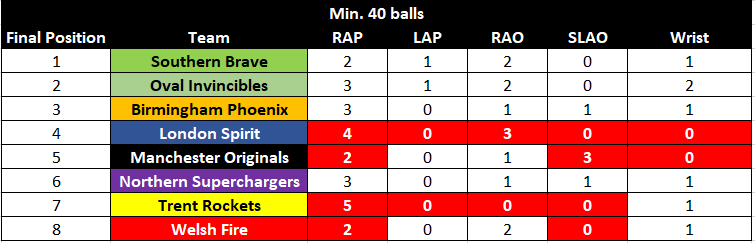
Recruitment is undervalued at times. One thing you desperately need in the shorter formats is a variety in your bowling attack. Look at the teams that did not qualify and look at the variety or the lack of it that they possessed coming into the competition.
Trent Rockets
How could you go ahead with 5 RAPs in your team? Their 2/3 overseas’ signings also happened to be RAPs. They were genuinely good signings though and did a significantly high% job for their team.
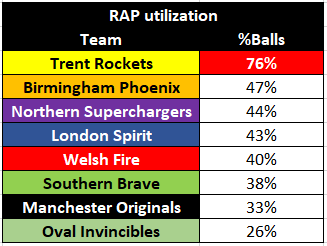
With so many RAPs, I was skeptical from the beginning that the talented off-spinners in Lucy Higham and Georgia Davis may not have much of a role to play. The spin department was always going to be about Sarah Glenn.
The downfall looked imminent from the get-go.
London Spirit
London Spirit had the 2nd highest no. of RAPs and the highest no. of RAOs in the side. Too much of one thing is always harmful and both teams would’ve hopefully learned their lessons.
A staggering 50% of deliveries were bowled by their three off-spinners. I agree that those three off-spinners were high-quality, but how does that matter when you compare the same with no variety? Their only SLAO was Chloe Tryon, who is not a regular and bowled just 20 balls in the entire competition. No wrist-spinner either in the side!
Their only LAP was Naomi Dattani, another bowler who is not a regular and was extremely expensive in her 35 balls.
2. WRONG BATTING ORDER
This was a common issue across the board in this competition barring Southern Brave & Manchester Originals. The batting order of the other 6 teams was quizzical, and some of the teams like Welsh Fire & Trent Rockets lacked logic behind their batting order.
Trent Rockets
I talked about it several times on Twitter. But, from Game 1 to Game 8, Trent Rockets blindly persisted with Katherine Brunt at #4. To me, this move seemed like Trent wanting to back experience over youth when it came to batting and it made no sense to me!
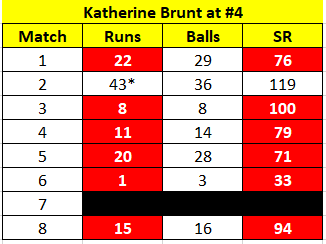
This move was despite the fact that there were far better technical/aggressive batters in the side like Heather Graham, Sarah Glenn, Kathryn Bryce, & Abigail Freeborn. Brunt has proven to be a powerhouse in the T20Is when she has batted lower down the order and added quick runs with just a few balls remaining in the innings. But, the longer she bats, the more ineffective she becomes.
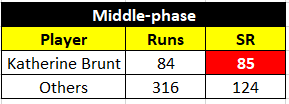
This wasn’t the end it. Her batting in the middle phase was one of the most crucial factors behind Trent falling well short of a par score on flat pitches. She had the lowest SR in the middle-phase out of all batters in the competition who faced a minimum of 50 balls.
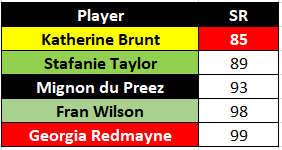
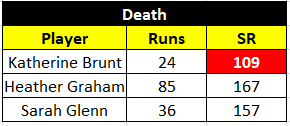
Why would you not back the youth? Heather Graham is a 100 times better technical player than Brunt, Sarah Glenn is a clean striker, and Abigail Freeborn is fairly decent as well. This was proven when Glenn followed Brunt in the last game and finished with 23* off just 12 balls.
Both Graham & Glenn batted below Brunt in all the games. Yet, the following was the outcome.
London Spirit
London Spirit suffered the same fate, but their initial call was very much justified. They started their campaign with Naomi Dattani and I could the logic behind it. But, as the competition progressed, the returns of Dattani as an opener diminished.
This yet again brings me to the same issue that I observe with some teams – Resistance to change! You come with Plan A, if it doesn’t work for a few games, you have to be quick in implementing Plan B in such short formats. If you keep persisting without logic, you’ll only plunge deeper as you move ahead. It acts like a quicksand!
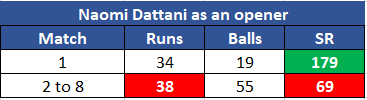
Why should have they looked to change this quickly once Beaumont joined the squad? That’s because they already had Deandra Dottin.
Dottin is an all-rounder by trade who hasn’t played much part with the ball because of injuries. It was a blessing that she did bowl for the first two games & opened the innings as well. From Game 3, Beaumont came into the side which saw Dottin getting demoted and she didn’t bowl even once from that game onwards.
So, her role was restricted to batting. Hence, shouldn’t London have put her in the opening slot after 5 games when the Dattani experiment failed and knowing that Dottin will only bat?
Dottin has done really well as an opener for the West Indies & she is like Sophie Devine. She will clear the boundaries with ease and such is her power game & striking. Not to forget, she was coming on the back of the Pakistan T20I series where she opened and scored 62 runs in 3 games with the highest SR in the team.
3. UNDER-UTILIZATION OF 10-BALL SETS
This has one of the most underrated tactic that has slipped under the radar. But, not completely. Only a few teams have realized the value of it and those are the very teams to have made the cut!
Trent Rockets
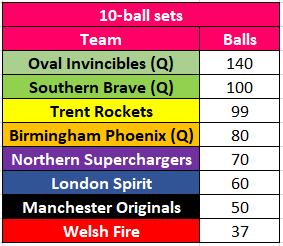
While you can see that Trent Rockets bowled 99 balls in their 10-ball sets, you don’t see who were the bowlers and how they were utilized by Nat Sciver for these sets.
It is not simply about giving the tenners to anyone and the move proving to be fruitful. It’s about the given situation and recognition of when it will work and for whom it will work. This is where the Rockets paid a hefty price.
The 10-ball sets bowled by Trent Rockets were one of the costliest amongst all teams. Sammy Jo-Johnson, who is the ideal bowler to bowl such sets, bowled only 1 such set which came as a desperate measure in their penultimate game against Birmingham Phoenix.
London Spirit
London Spirit had a simple case of not bowling enough tenners. Just 6 sets and that’s it. All of this despite having a miserly bowler in Deepti Sharma, a decent death bowler in Freya Davies, and a bowler in Charlotte Dean who managed to put the opposition in a stranglehold.
Pacers have been the best exponents of balling these sets. But, guess what? London Spirit only had Freya Davies as the pacer to bowl 1 such set for the entire competition.
4. OVER-RELIANCE ON THE OVERSEAS PLAYERS
The one thing I have to admit is that both teams had made more than decent overseas singings. All three players were very good in both teams and while one could argue about Chloe Tryon in hindsight, I still feel she was a very good signing who just couldn’t fire.
Trent Rockets
5 RAPs in the side, but it was the Sammy Jo-Johnson & Heather Graham show. The two overseas pacers took the bulk of wickets and steered the ship.

The batting saw them suffer the same fate. The class of Nat Sciver stood tall though! If your 3 overseas batters account for 46% of the runs, then there should be an extensive review on what should be done next year in terms of domestic recruitment.

London Spirit
London Spirit were alright on this count. Deepti Sharma had the biggest role to play when it came to bowling and that’s fine.
CONCLUSION
Even with such a team, they could’ve won the competition easily. The tactics were beyond shocking.
Trent Rockets
For Trent, it was all about wanting their top 5 to do all the job & not backing the youngsters and giving them an opportunity to showcase their talent. I personally did not like Nat Sciver’s captaincy so much.
The on-field tactics & field placements were bizarre almost every game.
London Spirit
London were again alright, but the problem was that they never clicked as a unit. Trevor Griffin is one of the best minds in cricket, so it’s surprising for them to not go through. They need to look at their bowling attack and the lack of variety.
Imagine the two teams with high-profile names like Nat Sciver, Rachel Priest, Sarah Glenn, Sammy Jo-Johnson, Katherine Brunt, Sarah Glenn, Heather Graham, Heather Knight, Deepti Sharma, Deandra Dottin, Tammy Beaumont, & Chloe Tryon not even making it to the top 3.
CONCLUSION:
Overall, it’s understandable for some tactics to go wrong as this was the first season of a competition with new rules. But, one can’t argue some of the basic errors and basic tactical howlers made by Nat Sciver & Kate Cross. If they continue to lead their respective sides next year, they’ll need to improve massively. I have somehow lost the trust very quickly after seeing some basics being compromised by the duo & it will be hard to back any team led by them.
 Cricket Strategist